
Introduction
In today’s competitive digital world, having an online presence is important, but simply being online is not enough. Your website, search engine visibility, social media presence, paid advertising, and overall digital strategy all play an important role in attracting and converting customers.
However, even a well-planned digital marketing strategy can fail because of small mistakes.
Are you making the right digital marketing decisions for your business?
At IFFECTUS, we believe that understanding common mistakes is just as important as learning successful strategies. In this article, we will explore 10 common SEO mistakes and 10 Google Ads mistakes that businesses should avoid.
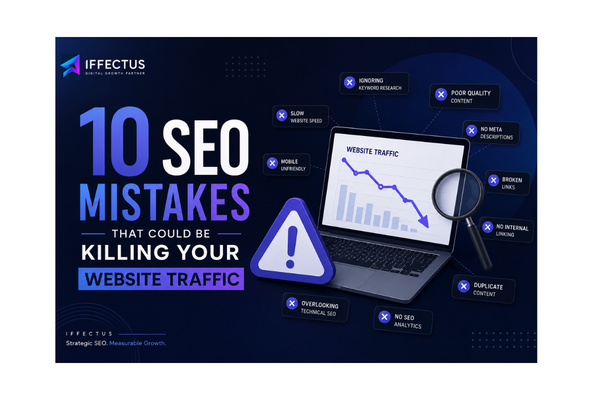 10 SEO Mistakes That Could Be Killing Your Website Traffic
SEO can help your website appear in search engine results and attract organic visitors. But when SEO is done incorrectly, it can have the opposite effect.
Here are 10 common SEO mistakes that could be affecting your website traffic.
1. Ignoring Keyword Research
Keywords help search engines understand what your content is about and what searches your website should appear for.
One common mistake is creating content without researching what your target audience is actually searching for. Choosing keywords randomly can result in low traffic and poor visibility.
Effective keyword research helps you understand search intent and create content that matches what users are looking for.
2. Keyword Stuffing
Using keywords is important, but using them excessively can make your content unnatural and difficult to read.
For example, repeating the same keyword unnecessarily throughout a page does not automatically improve rankings. Search engines focus increasingly on useful, relevant, and user-friendly content.
Instead of keyword stuffing, use keywords naturally while focusing on providing genuine value to readers.
3. Publishing Low-Quality Content
More content does not always mean better SEO.
Publishing short, repetitive, outdated, or unhelpful articles simply to increase the number of pages on your website can hurt your overall content quality.
Your content should answer users’ questions, provide useful information, and offer something valuable.
4. Ignoring Title Tags and Meta Descriptions
Title tags and meta descriptions help search engines and users understand what a webpage is about.
A poorly written title may fail to attract clicks even if the page ranks well. Similarly, missing or unclear meta descriptions can reduce the effectiveness of your search result.
Create clear, relevant, and compelling titles and descriptions for important pages.
5. Having a Slow Website
How long are visitors willing to wait for your website to load?
Website speed can influence user experience. If a website takes too long to load, visitors may leave before exploring your content.
Large images, unnecessary plugins, poor hosting, and unoptimized website elements can contribute to slow performance. Improving page speed can create a better experience for users.
6. Ignoring Mobile Optimization
A large number of users browse websites through smartphones and other mobile devices.
If your website does not work properly on smaller screens, users may struggle with navigation, reading content, filling forms, or completing purchases.
Your website should provide a smooth experience across different screen sizes.
7. Neglecting Internal Linking
Internal links connect different pages on your website.
Without proper internal linking, users and search engines may have difficulty discovering important pages. Strategic internal links can help visitors find related information and help search engines understand the structure of your website.
8. Ignoring Technical SEO
Technical SEO focuses on the technical aspects that help search engines crawl and understand your website.
Issues such as broken links, poor site structure, incorrect redirects, duplicate pages, indexing problems, and other technical issues can affect your website’s performance.
Regular technical SEO checks can help identify and fix these problems.
9. Not Optimizing Images
Images can improve content and make webpages more engaging, but large and unoptimized images can slow down your website.
Use appropriate image formats, compress large files, and add descriptive alternative text where appropriate. This can improve both accessibility and website performance.
10. Expecting Immediate Results
SEO is a long-term strategy.
One of the biggest mistakes businesses make is expecting significant traffic and rankings immediately after implementing SEO.
Search visibility takes time and depends on factors such as competition, website quality, content, authority, technical health, and consistency.
A successful SEO strategy requires patience, regular monitoring, and continuous improvement.
10 Google Ads Mistakes That Can Waste Your Advertising Budget
Google Ads can help businesses reach potential customers quickly, but poor campaign management can result in unnecessary spending.
Are your Google Ads generating real business results or just clicks?
Here are 10 common Google Ads mistakes businesses should avoid.
1. Choosing the Wrong Keywords
Keywords determine when your advertisements can appear.
Using keywords that are too broad or unrelated to your products and services can attract users who are unlikely to become customers.
Choosing relevant keywords based on search intent can help improve the quality of your traffic.
2. Ignoring Negative Keywords
Negative keywords help prevent your ads from appearing for irrelevant searches.
For example, if you sell premium products, certain searches containing terms such as “free” may not be relevant to your business.
Ignoring negative keywords can lead to unnecessary clicks and wasted advertising spend.
3. Writing Generic Ad Copy
Your advertisement needs to communicate why users should choose your business.
Generic headlines and descriptions may fail to capture attention. Effective ad copy should be relevant to the search, clearly communicate the value you offer, and provide an appropriate call to action.
4. Sending Everyone to the Homepage
A common mistake is directing every advertisement to the website homepage.
If someone searches for a specific service, sending them to a general homepage can create unnecessary steps.
A relevant landing page that matches the advertisement and search intent can provide a better user experience.
5. Not Tracking Conversions
Clicks and impressions do not necessarily mean business success.
Without conversion tracking, it can be difficult to understand whether your campaigns are generating leads, sales, sign-ups, calls, or other valuable actions.
Proper tracking helps businesses evaluate campaign performance and make better decisions.
6. Targeting the Wrong Audience or Location
Your ads should reach people who are actually relevant to your business.
Targeting the wrong locations or audiences can result in clicks from users who cannot or are unlikely to purchase your products or services.
Careful audience and location targeting can help improve campaign relevance.
7. Setting and Forgetting Your Campaign
Launching a Google Ads campaign does not mean the work is finished.
Campaigns need regular monitoring and optimization. Keywords, ads, budgets, targeting, and performance should be reviewed regularly.
Without optimization, businesses may continue spending money on elements that are not producing good results.
8. Ignoring Ad Extensions and Assets
Additional ad assets can provide users with more information and more ways to interact with your business.
Depending on the campaign and available features, these can highlight services, locations, offers, phone numbers, or other useful information.
Ignoring relevant assets can mean missing opportunities to make your advertisements more informative.
9. Focusing Only on Clicks
A high number of clicks may look impressive, but clicks alone do not guarantee success.
The real goal should be to attract relevant visitors who are likely to take valuable actions.
Businesses should look beyond clicks and consider metrics such as conversions, conversion value, cost per conversion, and return on advertising spend where appropriate.
10. Not Testing and Improving Your Ads
A campaign should not rely on one advertisement forever.
Testing different headlines, descriptions, landing pages, keywords, audiences, and strategies can help identify what performs better.
Regular testing allows businesses to learn from campaign data and gradually improve performance.
Why Do These Mistakes Matter?
SEO and Google Ads work differently, but both require strategy, consistency, and continuous improvement.
SEO focuses primarily on building organic visibility over time, while Google Ads can provide paid visibility when people search for relevant terms. Using either strategy without proper planning can lead to disappointing results.
The good news is that most marketing mistakes can be identified, corrected, and improved.
Build a Smarter Digital Marketing Strategy With IFFECTUS
At IFFECTUS, we understand that every business has different goals, audiences, and challenges. A strategy that works for one brand may not necessarily work for another.
That is why digital marketing should be approached with research, creativity, data, and continuous optimization.
From SEO and Google Ads to Social Media Marketing, Email Marketing, Web Development, and Graphic Design, every part of your digital presence can contribute to your overall growth.
Ready to Improve Your Digital Presence?
Start by identifying what is holding your business back.
Avoid common mistakes, understand your audience, create valuable content, optimize your campaigns, and continuously measure your results.
Learn smarter. Market better. Grow digitally with IFFECTUS.